
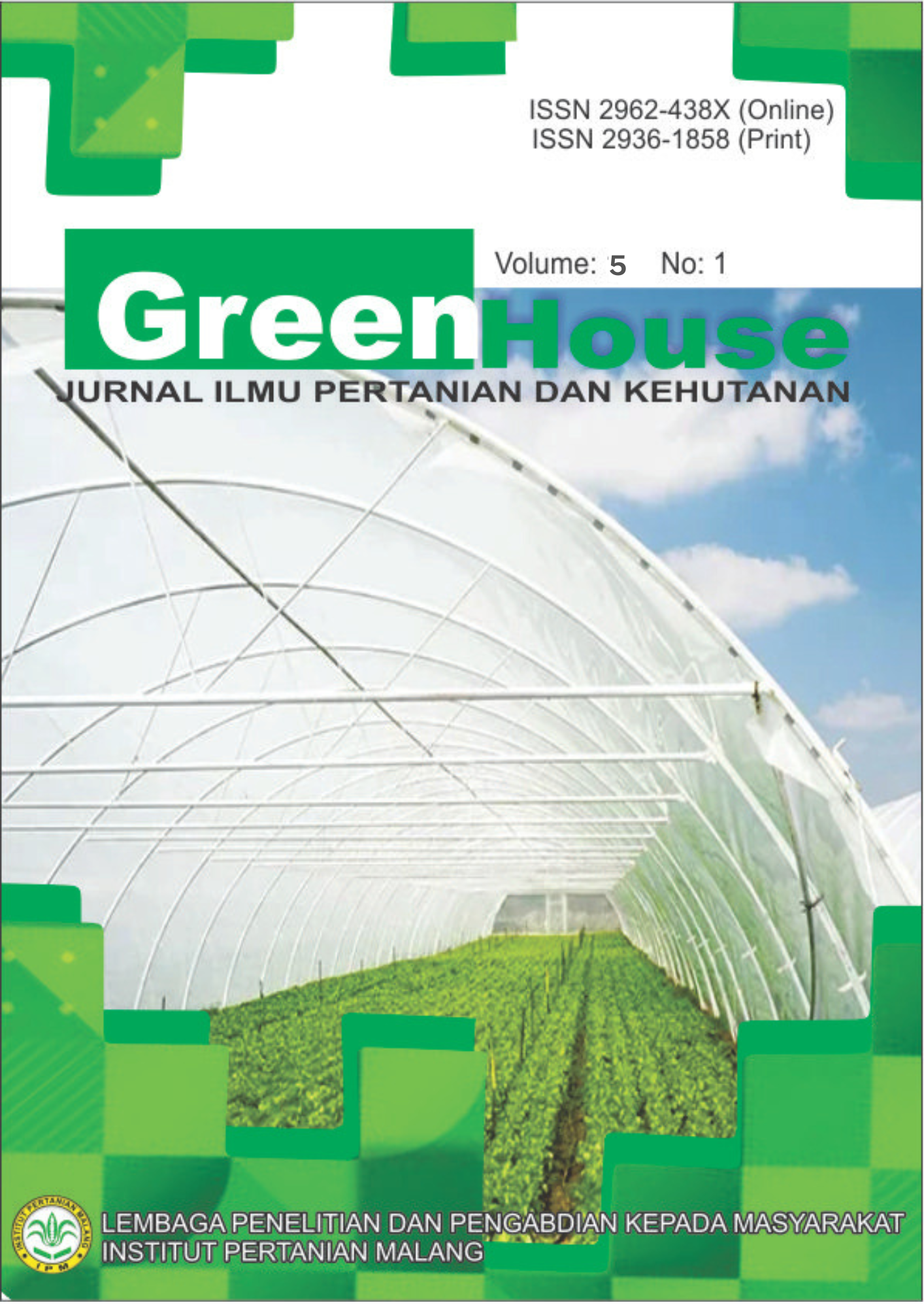

Vol. 5 No. 1 (2026): Jurnal Green House
Full Issue
Table of Content
-
Respons Petani terhadap Penyuluhan Kastrasi Tanaman Kelapa Sawit Rakyat Berdasarkan Good Agricultural Practices (GAP) di Kecamatan Sirapit, Kabupaten Langkat
Adam Raihan Politeknik Pembangunan Pertanian Medan Indonesia , Yusra Muharami Lestari Politeknik Pembangunan Pertanian Medan Indonesia , Mukhtar Yusuf Politeknik Pembangunan Pertanian Medan IndonesiaRendahnya adopsi teknik kastrasi pada tanaman kelapa sawit fase Tanaman Belum Menghasilkan (TBM) menghambat penerapan Good Agricultural Practices (GAP). Kondisi ini menunjukkan perlunya penyuluhan yang disusun berdasarkan kebutuhan petani. Penelitian ini bertujuan menyusun rancangan penyuluhan berbasis Identifikasi Potensi Wilayah (IPW) serta mengevaluasi efektivitasnya.Penelitian ini menggunakan metode Penelitian kuantitatif dengan desain one-group pretest-posttest dilaksanakan pada Maret–Mei 2026 di Kecamatan Sirapit, Kabupaten Langkat. Seluruh 33 petani dijadikan responden melalui teknik sampling jenuh. Data dikumpulkan menggunakan kuesioner skala Likert yang telah memenuhi uji validitas (r = 0,379–0,985) dan reliabilitas (Cronbach's Alpha = 0,622–0,982). Rancangan penyuluhan memperoleh skor efektivitas 78,23%. Sikap petani terhadap penerapan GAP mencapai 85,61%, sedangkan 16 dari 33 petani (58,78%) telah menerapkan teknik kastrasi secara mandiri setelah penyuluhan.Rancangan penyuluhan berbasis IPW efektif meningkatkan penerimaan petani terhadap teknologi kastrasi dan mendorong adopsi awal GAP. Pendampingan berkelanjutan dan demonstrasi lapangan tetap diperlukan untuk meningkatkan penerapan teknologi secara konsisten
Pages: 1-10Views: 0 Downloads: 0Analisis Perkembangan Bisnis Melalui Pendekatan Multiaspek di UMKM Pia Sekar
Biaggi Takwa Adinegoro Institut Pertanian Malang Indonesia , Niniek Dyah Kusumawardani Institut Pertanian Malang Indonesia , Nunuk Hariyani Institut Pertanian Malang IndonesiaAgribisnis mencakup seluruh rangkaian aktivitas, mulai dari penyediaan sarana produksi, proses budidaya, pengolahan hasil, hingga pemasaran produk pertanian. Dalam rantai tersebut, Usaha Mikro, Kecil, dan Menengah (UMKM) kuliner memiliki peran strategis sebagai penggerak ekonomi lokal. Penelitian ini bertujuan untuk menganalisis perkembangan bisnis UMKM Pia Sekar serta mengidentifikasi strategi dan langkah yang diterapkan dalam pengembangan usahanya. Penelitian dilakukan di rumah produksi Pia Sekar pada Oktober–November 2025 dengan pendekatan deskriptif kualitatif. Data diperoleh melalui observasi, wawancara, serta dokumentasi, yang terdiri atas data primer dari pemilik usaha dan data sekunder dari Badan Pusat Statistik (BPS). Instrumen penelitian meliputi kamera, alat perekam suara, kuesioner, dan catatan lapangan, sedangkan responden dipilih menggunakan teknik purposive sampling. Analisis dilakukan berdasarkan enam aspek, yaitu legalitas, pasar dan pemasaran, teknis dan operasional, manajemen dan organisasi, lingkungan, serta keuangan. Hasil penelitian menunjukkan bahwa Pia Sekar mengalami perkembangan pada seluruh aspek tersebut. Dari sisi legalitas, usaha telah memenuhi ketentuan regulasi yang berlaku. Aspek pasar dan pemasaran berkembang melalui perluasan target pasar dari institusi ke ritel oleh-oleh, didukung promosi digital dan pembaruan kemasan. Pada aspek teknis dan operasional diterapkan sistem produksi berbasis pesanan. Manajemen usaha masih sederhana dan terpusat pada pemilik dengan hubungan kerja yang harmonis. Dari aspek lingkungan, limbah produksi dikelola melalui pemanfaatan kembali, daur ulang, dan pengomposan. Aspek keuangan menunjukkan kemandirian modal tanpa pembiayaan eksternal disertai marjin keuntungan yang stabil. Kebaruan penelitian ini terletak pada kajian komprehensif perkembangan bisnis UMKM berdasarkan enam aspek tersebut sekaligus mengidentifikasi strategi pengembangan usaha yang diterapkan Pia Sekar.
Pages: 11-20Views: 0 Downloads: 0Karakteristik Fisikokimia, Antioksidan, dan Total Fenolik Minuman Enkapsulasi Daun Labu Siam
Connie Daniela sinagasimbolon Universitas Katolik Santo Thomas Indonesia , Dewi Restuana Sihombing Universitas Katolik Santo Thomas Indonesia , Maruba Pandiangan Universitas Katolik Santo Thomas IndonesiaPeningkatan kesadaran masyarakat terhadap pola hidup sehat mendorong pengembangan pangan fungsional berbasis bahan nabati yang kaya senyawa bioaktif. Daun labu siam (Sechium edule) berpotensi dikembangkan sebagai minuman fungsional karena mengandung senyawa fenolik dan antioksidan, namun stabilitas senyawa tersebut dapat menurun selama proses pengolahan dan pengeringan. Penelitian ini bertujuan untuk menganalisis pengaruh konsentrasi maltodekstrin dan lama pengeringan terhadap karakteristik fisikokimia, aktivitas antioksidan, dan total fenolik minuman fungsional enkapsulasi daun labu siam. Penelitian menggunakan Rancangan Acak Lengkap (RAL) faktorial dengan dua faktor, yaitu konsentrasi maltodekstrin (5%, 10%, 15%, dan 20%) serta lama pengeringan (2, 4, 6, dan 8 jam). Parameter yang diamati meliputi rendemen, kadar air, kelarutan, aktivitas antioksidan (IC₅₀), dan total fenolik. Data dianalisis menggunakan ANOVA dan dilanjutkan dengan uji DMRT pada taraf 5%. Hasil penelitian menunjukkan bahwa kedua faktor berpengaruh nyata (p<0,05) terhadap seluruh parameter yang diamati. Peningkatan konsentrasi maltodekstrin dan lama pengeringan meningkatkan rendemen dan kelarutan serta menurunkan kadar air, namun menurunkan total fenolik. Nilai aktivitas antioksidan terbaik diperoleh pada perlakuan maltodekstrin 20% dan pengeringan 6 jam. Disimpulkan bahwa kombinasi maltodekstrin 20% dan lama pengeringan 6 jam menghasilkan karakteristik produk yang paling seimbang serta berpotensi dikembangkan sebagai minuman fungsional serbuk berbasis daun labu siam.
Pages: 21-30Views: 0 Downloads: 0Pengaruh Jenis Kemasan terhadap Umur Simpan dan Kualitas Organoleptik Produk Pia di UMKM Pia Sekar, Tunjungsekar Malang
Aflin Nggupa Aji Institut Pertanian Malang Indonesia , Diena Widyastuti Institut Pertanian Malang Indonesia , Alvin Candra Wijaya Institut Pertanian Malang IndonesiaPia atau bakpia merupakan produk olahan pangan berisi kacang hijau yang memiliki umur simpan relatif singkat sehingga pemilihan jenis kemasan penting dalam mempertahankan mutunya. Penelitian ini bertujuan mengetahui pengaruh jenis kemasan terhadap penerimaan organoleptik pia UMKM Pia Sekar, Tunjungsekar, Malang, selama 10 hari penyimpanan serta menentukan kemasan yang paling efektif. Empat jenis kemasan diujikan, yaitu dus karton, wadah plastik kaku transparan, besek anyaman bambu, serta kemasan standar UMKM berupa dus yang dipadukan dengan kantong plastik oriented polypropylene (OPP). Warna, aroma, rasa, dan tekstur dinilai oleh 15 panelis tidak terlatih menggunakan skala hedonik 1–4 pada hari ke-1, ke-5, dan ke-10, kemudian dianalisis menggunakan analisis ragam (ANOVA) satu arah pada taraf 5%. Jenis kemasan berpengaruh nyata terhadap rasa dan tekstur pada hari ke-1 serta aroma dan tekstur pada hari ke-5, sedangkan warna tidak berbeda nyata selama penyimpanan. Wadah plastik kaku dan dus–OPP mempertahankan karakteristik sensori yang masih dapat diterima hingga hari ke-10, sedangkan besek hanya sesuai untuk penyimpanan singkat karena produk mengering dan menyerap aroma bambu. Hasil ini menggambarkan penerimaan sensori dan belum merupakan validasi umur simpan secara mikrobiologis.
Pages: 31-37Views: 0 Downloads: 0Pengaruh Sistem Agroforestri terhadap Keanekaragaman Jenis Kupu-Kupu (Lepidoptera) di Kawasan Wana Wisata Bedengan, Malang
Agatha Herkulana Seran Institut Pertanian Malang Indonesia , Yani Quarta Mondiana Institut Pertanian Malang Indonesia , Anisa Zairina Institut Pertanian Malang IndonesiaAgroforestri merupakan sistem pengelolaan lahan yang memadukan tanaman kehutanan, pertanian, dan/atau peternakan dalam satu unit lahan, yang diharapkan mampu mendukung konservasi keanekaragaman hayati, termasuk kupu-kupu (Lepidoptera) yang berperan sebagai penyerbuk dan bioindikator kualitas lingkungan. Penelitian ini bertujuan untuk mengetahui tingkat keanekaragaman jenis kupu-kupu pada habitat agroforestri dan non-agroforestri di Kawasan Wana Wisata Bedengan, Malang, serta menganalisis pengaruh sistem agroforestri terhadap keanekaragaman tersebut. Pengumpulan data dilakukan melalui survei dan observasi langsung menggunakan metode transek garis sepanjang 150 m pada dua tipe habitat, yang diulang sebanyak empat kali selama satu bulan. Keanekaragaman jenis dianalisis menggunakan indeks Shannon-Wiener, sedangkan perbedaan antarhabitat diuji dengan uji t Hutchinson. Hasil penelitian menunjukkan terdapat 30 spesies kupu-kupu pada habitat agroforestri dan 16 spesies pada habitat non-agroforestri dari empat famili yang didominasi oleh Nymphalidae. Nilai indeks Shannon-Wiener sebesar 3,313 (kategori tinggi) pada habitat agroforestri dan 2,707 (kategori sedang) pada habitat non-agroforestri. Uji Hutchinson menghasilkan nilai t-hitung 3,497 yang lebih besar dari t-tabel 2,09302 (df = 19, α = 0,05), yang menunjukkan perbedaan signifikan antara kedua habitat. Sistem agroforestri, melalui struktur vegetasi berlapis, ketersediaan pakan yang lebih beragam, dan mikroklimat yang lebih stabil, mendukung keanekaragaman kupu-kupu yang lebih tinggi dibandingkan area non-agroforestri sehingga layak direkomendasikan sebagai strategi tata guna lahan untuk konservasi serangga penyerbuk di kawasan ekowisata.
Pages: 38-45Views: 0 Downloads: 0Analisis Keanekaragaman Jenis dan Status Konservasi Burung di Wana Wisata Bedengan
Alfonsus Dappa Institut Pertanian Malang Indonesia , Poegoeh Prasetyo Rahardjo Institut Pertanian Malang Indonesia , Yani Quarta Mondiana Institut Pertanian Malang IndonesiaBurung berperan penting sebagai penyerbuk, penyebar biji, pengendali hama, dan indikator kesehatan lingkungan, serta sensitif terhadap perubahan habitat. Penelitian ini bertujuan untuk mengetahui keanekaragaman dan status konservasi burung di lahan agroforestri (perpaduan tanaman pertanian dan pepohonan) dan non-agroforestri (lahan pertanian intensif atau non-kehutanan) di Wana Wisata Bedengan, serta menganalisis perbedaan keanekaragaman jenis burung antara kedua tipe habitat tersebut. Penelitian ini dilaksanakan di Wana Wisata Bedengan, Desa Selorejo, Kecamatan Dau, Kabupaten Malang, Jawa Timur, pada Mei–Juni 2025, menggunakan metode kuantitatif deskriptif. Data dianalisis menggunakan indeks keanekaragaman Shannon-Wiener dan dibandingkan antara habitat agroforestri dan non-agroforestri. Hasil penelitian menunjukkan bahwa keanekaragaman jenis burung pada lahan agroforestri (H' = 3,03) lebih tinggi dibandingkan lahan non-agroforestri (H' = 2,0936), dan perbedaan tersebut signifikan secara statistik (p < 0,05). Mayoritas spesies yang ditemukan berstatus Least Concern, namun keberadaan beberapa spesies yang dilindungi dan berstatus Rentan (Vulnerable) menunjukkan pentingnya upaya konservasi di kawasan tersebut.
Pages: 46-54Views: 0 Downloads: 0Studi Pola Penyebaran dan Pemanfaatan Tumbuhan Kaliandra (Calliandra spp.) di Javan Langur Center
Winelci Anjelina Nasi Tadon Institut Pertanian Malang Indonesia , Sri Sulastri Institut Pertanian Malang Indonesia , Poegoeh Prasetyo Rahardjo Institut Pertanian Malang IndonesiaKaliandra (Calliandra spp.) banyak dimanfaatkan sebagai pakan, tetapi regenerasinya yang cepat dan kemampuannya mendominasi lokasi terganggu perlu diperhatikan pada kawasan rehabilitasi satwa. Penelitian ini menganalisis pola sebaran dan pemanfaatan kaliandra di Javan Langur Center (JLC) sebagai dasar untuk menyeimbangkan ketersediaan pakan dan pengelolaan vegetasi. Data vegetasi dikumpulkan secara purposive pada tiga blok (sekitar kantor kerja, karantina, dan sosialisasi), masing-masing menggunakan tiga petak bersarang berukuran 5 × 5 m untuk pancang dan 2 × 2 m untuk semai. Seluruh individu kaliandra pada setiap petak dihitung. Data pemanfaatan diperoleh melalui wawancara terhadap sepuluh masyarakat sekitar dan dua pengelola JLC, kemudian dianalisis secara deskriptif. Nilai indeks Morisita berkisar 1,011–1,390 pada tingkat pancang dan 1,049–1,342 pada tingkat semai, yang menunjukkan pola mengelompok. Sebanyak 349 individu pancang dan 130 individu semai tercatat; jumlah pancang tertinggi terdapat di blok sosialisasi (141 individu), sedangkan jumlah semai tertinggi terdapat di blok karantina (48 individu). Masyarakat terutama memanfaatkan kaliandra sebagai pakan ternak, serta sebagai bibit, sayur, kayu bakar, gagang alat, dan lanjaran; JLC memanfaatkannya sebagai pakan harian dan bahan pengayaan bagi lutung Jawa. Pemanenan selektif dan pemantauan regenerasi semai–pancang secara berkala direkomendasikan untuk menjaga pasokan pakan tanpa meningkatkan dominasi kaliandra terhadap vegetasi lokal.
Pages: 55-60Views: 0 Downloads: 0Analisis Strategi Pemasaran UMKM Pia Sekar Menggunakan SWOT di Kelurahan Tunjungsekar, Kota Malang
Yeflin Tendi Institut Pertanian Malang Indonesia , Didik Suprayitno Institut Pertanian Malang Indonesia , Gettik Andri Purwanti Institut Pertanian Malang IndonesiaUMKM Pia Sekar menghadapi peningkatan persaingan, resep yang mudah ditiru, fluktuasi harga, keterbatasan modal, dan promosi digital yang terbatas. Penelitian ini bertujuan (1) mengidentifikasi faktor strategis internal dan eksternal serta (2) merumuskan strategi pemasaran yang tepat bagi Pia Sekar. Penelitian dilaksanakan di UMKM Pia Sekar, Jl. Simpang Piranha Atas No. 48 A, Kelurahan Tunjungsekar, Kota Malang, pada Oktober–November 2025. Pemilik usaha dipilih secara purposif sebagai informan kunci, sedangkan seluruh 20 konsumen dalam populasi terjangkau selama periode penelitian dijadikan responden. Data primer diperoleh melalui observasi, wawancara, dan kuesioner, sedangkan data sekunder berasal dari dokumen dan literatur ilmiah relevan. Data dianalisis secara deskriptif kuantitatif menggunakan Internal Factor Analysis Summary (IFAS), External Factor Analysis Summary (EFAS), dan matriks SWOT. Skor IFAS dan EFAS setelah normalisasi masing-masing sebesar 2,634 dan 3,163. Koordinat SWOT (1,171; 0,558) menempatkan Pia Sekar pada Kuadran I, sehingga arah strategi utamanya adalah strategi pertumbuhan SO. Strategi tersebut memanfaatkan pemasok terpercaya, legalitas produk, harga terjangkau, dan pengalaman karyawan untuk mempertahankan mutu produk sekaligus memperluas promosi digital, hubungan pelanggan, dan kemitraan distribusi.
Pages: 61-69Views: 0 Downloads: 0Analisis Korelasi antara Kapasitas Kerja dan Konsumsi Bahan Bakar Rice Combine Harvester Tipe Maxxi Bimo 102 pada Pemanenan Padi
Nining Pambudi Astuti Institut Pertanian Malang Indonesia , Siti Armilda Lailani Irsyada Universitas Brawijaya Indonesia , Labib Hilia Rahman Institut Pertanian Malang Indonesia , Dwi Astutik Balai Penyuluhan Pertanian, Kabupaten Tulungagung IndonesiaPemanenan padi merupakan tahap penting dalam produksi yang sangat menentukan efisiensi kerja dan penggunaan energi. Penggunaan rice combine harvester tipe Maxxi Bimo 102 menjadi salah satu bentuk mekanisasi untuk meningkatkan efektivitas panen, namun kinerjanya dipengaruhi oleh kondisi lapangan serta hubungan antara kapasitas kerja dan konsumsi bahan bakar. Penelitian ini bertujuan untuk menganalisis hubungan antara kapasitas kerja dan konsumsi bahan bakar combine harvester tersebut pada kondisi lahan aktual. Pengamatan dilakukan pada beberapa petak lahan meliputi kapasitas lapang efektif, kapasitas lapang teoritis, waktu kerja, kecepatan operasi, serta konsumsi bahan bakar per jam dan per hektare. Hasil pengamatan menunjukkan adanya variasi kapasitas lapang efektif akibat kondisi lahan dan waktu tidak produktif. Peningkatan kapasitas kerja cenderung meningkatkan konsumsi bahan bakar per jam, tetapi menurunkan konsumsi bahan bakar per hektare karena waktu kerja lebih singkat. Secara keseluruhan, kinerja combine harvester menunjukkan bahwa efisiensi operasional sangat ditentukan oleh keseimbangan antara kapasitas kerja dan konsumsi bahan bakar, sehingga optimalisasi pengoperasian menjadi kunci dalam meningkatkan efisiensi mekanisasi panen padi.
Pages: 70-80Views: 0 Downloads: 0Pengembangan Puff Pastry Berbasis Substitusi Tepung Talas (Colocasia Esculenta) Sebagai Inovasi Diversifikasi Pangan Lokal
Dea Shania Purnomo Universitas Widya Gama Malang Indonesia , Frida Dwi Anggraeni Anggraeni Universitas Widya Gama Malang IndonesiaPemanfaatan umbi talas sebagai sumber pangan lokal belum dimanfaatkan secara optimal, padahal bahan ini memiliki prospek signifikan sebagai alternatif pengganti tepung terigu. Salah satu strategi untuk meningkatkan nilai tambah talas yaitu diolah menjadi tepung dan aplikasinya pada produk pastry. Penelitian ini difokuskan pada analisis pengaruh substitusi tepung talas (Colocasia esculenta) terhadap sifat organoleptik puff pastry. Pendekatan penelitian bersifat eksperimental dengan variasi kadar substitusi tepung talas (25%, 50%, 75%) dalam formulasi puff pastry. Uji organoleptik dilakukan oleh panelis semi-terlatih melalui parameter warna, aroma, rasa, dan tekstur. Analisis data bersifat deskriptif untuk mengukur tingkat preferensi panelis terhadap produk akhir. Hasil penelitian mengindikasikan bahwa semakin tinggi substitusi tepung talas berdampak pada semua parameter organoleptik, yakni perubahan warna menjadi lebih kusam, intensitas aroma khas talas yang lebih menonjol, modifikasi profil rasa, serta tekstur yang cenderung lebih kompak dan kurang ekspansif berlapis. Meskipun demikian, pada level substitusi optimal, produk tetap memperoleh penerimaan yang memadai dari panelis. Simpulan utama penelitian ini menyatakan bahwa tepung talas memiliki potensi sebagai pengganti parsial tepung terigu dalam produksi puff pastry, sekaligus mendukung upaya diversifikasi pangan berbasis sumber daya lokal.
Pages: 81-91Views: 0 Downloads: 0Sintesis Bio-Filter Magnetik Komposit Karbon Kulit Pisang–Fe₃O₄ untuk Adsorpsi Efisien Mikroplastik Akuatik
Muhammad Syauqi SMA Brawijaya Smart School Indonesia , Rika Wahyuni Arsianti Universitas Borneo Tarakan Indonesia , Mulyadi - universitas borneo tarakan IndonesiaPolusi mikroplastik merupakan ancaman serius bagi ekosistem perairan yang sulit diatasi dengan filtrasi konvensional. Penelitian ini mengembangkan Bio-Filter Magnetik berbasis Karbon Kulit Pisang (KKP) dan Magnetit ( Fe₃O₄) untuk menyisihkan mikroplastik secara efisien. KKP disintesis melalui karbonisasi (500°C) dan aktivasi KOH, kemudian dikompositkan dengan Fe₃O₄. Dua variasi rasio diuji (9:1 dan 7:3) untuk menentukan performa terbaik. Hasil menunjukkan bahwa rasio 7:3 memberikan efektivitas adsorpsi tertinggi sebesar 87,28% dengan waktu pemisahan magnetik tercepat selama 48 menit. Total waktu produksi adsorben adalah 4 hari 19 jam 15 menit. Hasil ini membuktikan bahwa Bio-Filter Magnetik KKP- Fe₃O₄ merupakan solusi ramah lingkungan, ekonomis, dan aplikatif untuk mengatasi kontaminasi mikroplastik di perairan.
Pages: 92-100Views: 0 Downloads: 0Additional Menu
Journal Template
Tools



Index




ISSN BARCODE

E-ISSN
P-ISSNVisitors
About the Journal
Jurnal Green House (JGH) akan menerbitkan hasil penelitian atau ulasan ilmiah dengan fokus tema bidang Ilmu Pertanian dan Ilmu Kehutanan (Agribisnis, Agroteknologi, Teknologi Industri Pertanian, Teknologi Pangan, Konservasi Sumberdaya Hutan, Ilmu Lingkungan) dan lain-lain. JGH akan terbit setiap bulan Januari dan Juli.
e-ISSN: 2962-438X
p-ISSN: 2963-1858Quick links
EXTERNAL LINK
Lembaga Penelitian dan Pengabdian kepada Masyarakat Institut Pertanian Malang
Jl. Soekarno-Hatta Malang, Jawa Timur IndonesiaEmail: lppm@jghipm.com
WA/Telp: 0341-495541
Sanguline Theme by Sangu Ilmu

